
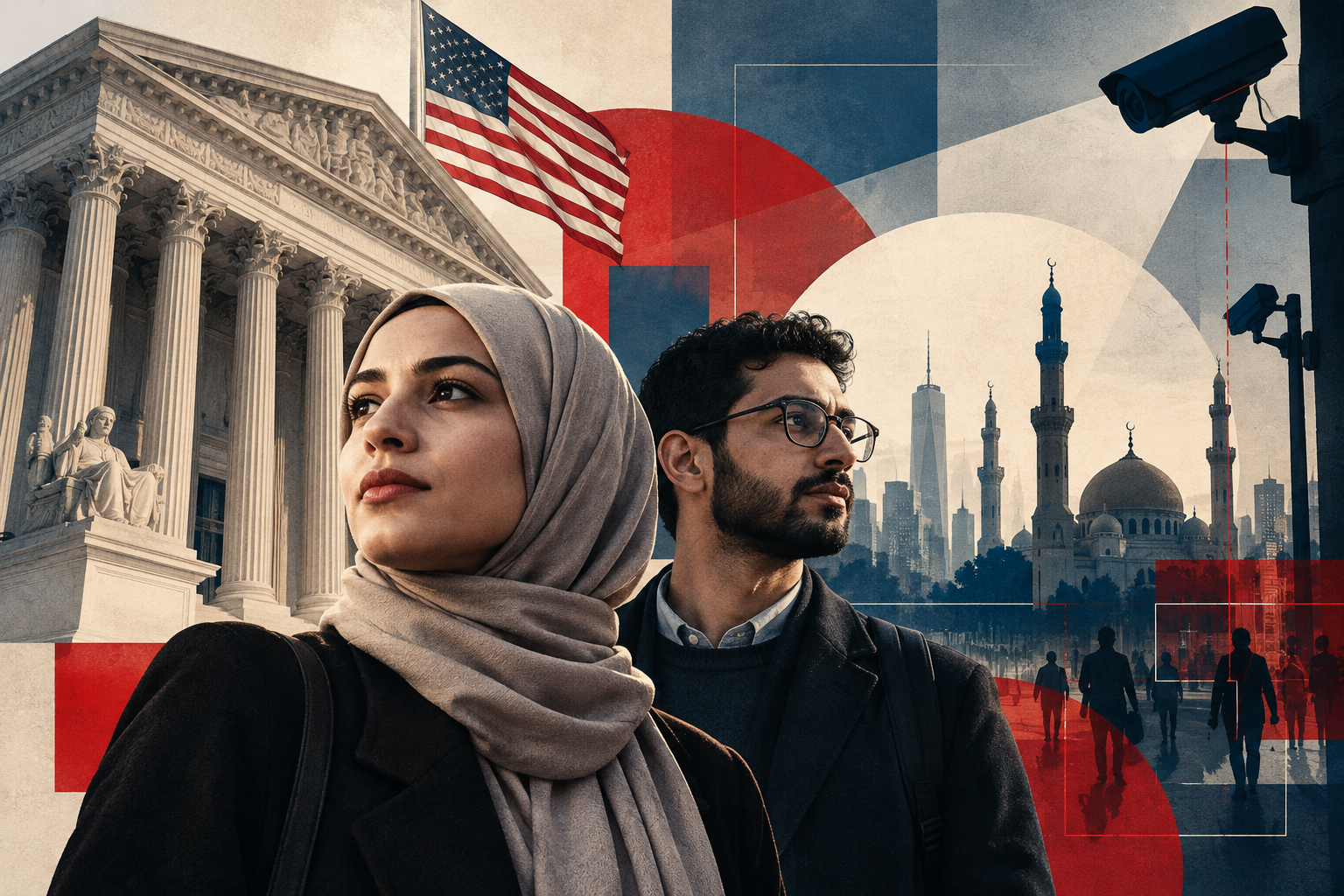




In an interview about her new book, Rozina Ali discusses the rise of Islamophobia and its manifestations in the United States. Speaking with Michael Young in an interview published by Diwan, the blog of the Malcolm H. Kerr Carnegie Middle East Center and the Middle East Program at the Carnegie Endowment for International Peace, the journalist and author examines the historical and political roots of Islamophobia in the United States, the impact of security and counterterrorism policies on American Muslims, and the changes taking place in public attitudes toward Islam and Muslims.
Rozina Ali is a journalist and contributing writer at The New York Times Magazine and a fellow at the Type Media Center. She was previously a fellow at New America and the Cullman Center for Scholars and Writers, and formerly served as a senior editor at The Cairo Review of Global Affairs. Her recent book, Seasons of Fury: Four Families and the Rise of Islamophobia (Penguin Random House, 2026), was longlisted for the 2026 National Book Awards. Diwan interviewed Ali in late October to discuss her new book.
Michael Young: How widespread is Islamophobia in the United States? You concluded your book by writing, “The truth is, it is here,” and then added that this is one story of America. But you also suggested that there is another story. Can you explain?
Rozina Ali: First, I want to make clear that part of my purpose in writing this book was to establish that discrimination against Muslims exists in the United States. Many Americans do not acknowledge that it exists or believe the accusation is fabricated. It is important to establish that anti-Muslim prejudice exists and then explain how it has intensified and why it has become more severe over the past several decades. That is why I ended the book with the phrase, “The truth is, it is here.”
It is also true that Islamophobia has become worse than it was in the past. The vitriolic rhetoric directed at Muslims and Islam by senior policymakers—including the president—and commentators has reached a level I have never seen before.
At the same time, the United States is a vast country, both geographically and politically. In New York, for example, anti-Muslim messaging directed against Zohran Mamdani failed to frighten voters. He remains remarkably popular despite the persistence of this bigotry. In Michigan as well, we can see that similar anti-Muslim rhetoric has not gained traction with a broad base of American voters as it once did.
This cannot be attributed solely to Mamdani’s influence, but rather to a combination of changes that have taken place over the past several decades: the growing presence of Muslims in political and public life; increasing public disillusionment with policymakers; and a greater willingness among Americans to criticize U.S. foreign policy and listen to criticism of it.
As I argue in my book, widespread Islamophobia has evolved and has become the product of decisions we have made over the years. That also means it is not necessarily an eternal or immutable problem within American society.
Young: How did your personal experiences as an American Muslim shape the book?
Ali: A reader of my book may notice that I rarely appear in the narrative. I appear only a few times throughout its pages because I tried to approach the subject from the perspective of an investigative journalist. But I would have been doing readers a disservice if I had ignored my personal background.
It was important for me to establish from the outset that being an American Muslim helped shape my political understanding of the United States and my place within it, and to explain why I ultimately embarked on this project.
At the same time, the entire book is grounded in my understanding that American Muslims practice their religion in different ways and that faith shapes their political interpretations of the world in highly diverse ways.
That deeper familiarity allowed me to challenge American assumptions about Muslims through my research into the U.S. counterterrorism surveillance system, the ways courts handle terrorism cases, and how policymakers and the public discuss Islam.
Young: You begin the book by discussing the case of Abdeen Jabara, one of the early representatives of the Arab American community, and the government’s surveillance of him. Do you distinguish between Islamophobia and anti-Arab prejudice? In other words, did official suspicion gradually shift from targeting Arabs—primarily for political reasons—to targeting Muslims more broadly, based on the belief, however mistaken, that Islam itself makes them dangerous?
Ali: There is a tendency in the United States to categorize discrimination according to the groups being targeted, and this tendency may be reinforced by the way hate-crime data are collected and measured. But reality is more complicated.
Islamophobia and anti-Arab prejudice can be distinct phenomena, but they also overlap, particularly in the minds of people who regard Arabs and Muslims as interconnected categories. I think most Americans still do not realize that many Arabs are not Muslim and that most Muslims are not Arab. The same was also true of many people working in law enforcement.
The common denominator between official discrimination against Arabs and discrimination against Muslims, however, is that both groups were treated as potential threats to national security with alleged connections to militant organizations abroad.
Official suspicion expanded from the surveillance of Arabs specifically in the 1970s and 1980s to the surveillance of Muslims more broadly in the 1990s. There were several reasons for this, including increased immigration to the United States by non-Arab Muslims, the rise of political Islam in parts of the world, and the U.S. government’s perception of Islamist terrorism as its principal enemy after the collapse of the Soviet Union.
By September 2001, suspicion and surveillance of Muslim communities in the United States had already been underway for years.
Young: Can you describe the period after the September 11 attacks and how the government dealt with Muslims in the United States? What were the main lessons from that period, and has the situation fundamentally changed since then?
Ali: Most people remember George W. Bush publicly expressing support for Muslims in the days after the September 11 attacks, when he visited a mosque and declared that “Islam is peace.” Yet even as he was making that statement, the government was targeting the Muslim population in unprecedented ways.
One of the most effective tools it used was the adoption of immigration policies that allowed thousands of Muslims to be detained and deported.
At the same time, many officials within the government sought to work with Muslim communities and involve them in counterterrorism efforts. At the urging of several officials, the Justice Department established a hotline to assist American Muslims who were facing harassment and attacks.
But the government often treated Muslim communities as objects of suspicion. It monitored mosques, Islamic centers, and restaurants, and surveilled telephone conversations and email correspondence. This did not apply only to Muslim immigrants; it also extended to Muslims who were U.S. citizens or who worked for the government.
What we have seen since then is a gradual move away from some of the blunt methods used in the first years after September 11, such as mass surveillance or the creation of a national registry for “nonimmigrant aliens.” This was due in part to lawsuits filed over the years challenging such practices, or because those methods were no longer necessary.
Today, the government’s surveillance network is more sophisticated than it was after September 11.
What is also troubling, however, is that the government is no longer the only actor conducting surveillance. More groups and ordinary citizens are now doing the same.
At the same time, the public’s willingness to support sweeping policies directed against Muslims appears limited, particularly amid growing distrust of the federal government and increasing calls to abolish Immigration and Customs Enforcement.
As voices promoting Islamophobia have grown louder, so too have voices rejecting the government’s hard-line approach to immigration and national-security measures.
Young: Looking at the broader landscape, we can see a shift in attitudes toward Israel within the United States. Do you expect this shift to affect how the American public views Muslims in the country as well?
Ali: The shift in attitudes toward Israel is extremely important. It is occurring alongside a broader willingness to criticize U.S. foreign policy and its wider war on terror.
It has become more difficult to promote the narrative that a Muslim militant who attacks the United States does so simply because he is evil.
Mamdani’s victory, despite his repeated and sharp criticism of Israel, is also significant.
But translating this change into broader public perceptions of Islam and Muslims will happen gradually. Muslims make up a very small proportion of the U.S. population—around 1.5 percent or so—and most Americans have become accustomed to a particular narrative about Islam and Muslims that has been repeated for thirty years.
Young: One of the themes you explore through the stories of Muslim individuals is that some sought to build mosques in the communities where they lived. Yet this often generated opposition from local communities. In a country where freedom of religion is considered a fundamental and deeply established principle, why were Muslims an exception in this regard, and what were the consequences?
Ali: It is difficult not to think here of Edward Said’s Orientalism.
What I found through my journalistic work is that there is an entrenched idea within both government and public opinion that Muslims are too foreign to be regarded as American, and that they will bring with them a malign external influence, whether financial or ideological.
Fear of foreign funding—specifically Arab money—has long been one of the main drivers of suspicion surrounding Islamic institutions in the United States.
The critics are not entirely wrong: Saudi Arabia, Qatar, the United Arab Emirates, and other countries funded mosques in the United States before the September 11 attacks.
The irony, of course, is that money from Gulf states is now invested in many different areas of American life, from banks and universities to the agricultural sector.
In addition, most of the government’s counterterrorism efforts during the 1990s—which intensified after 2001—focused on identifying sources of funding for terrorist networks, and law-enforcement agencies often targeted Islamic institutions.
Much of the local opposition to proposed mosque construction drew on both old and new theories about potential threats from Islamist terrorism, including funding, extremist ideology, and supposed hidden intentions among Muslims.
At the core of these accusations was the idea that Muslims would somehow corrupt the moral and cultural fabric of the United States. This reflects a misunderstanding both of how Islam is practiced and of how society itself functions.
Of course, efforts were made to challenge decisions rejecting mosque construction in the courts, but these efforts were fragmented: one might win a case in one city and lose another in a different city.
The result is that, generally speaking, we have failed at the national level to develop a cultural and political consensus over whether Islam has a place in America.
One need only look at efforts to ban public expressions of Islam in Texas.
Young: Another theme you discuss in describing the fate of one of your main characters is what I call the “Minority Report” phenomenon—that is, arresting Muslims not for crimes they have committed, but for crimes they might commit. How did the U.S. legal system justify such preemptive conduct, which raises serious legal concerns?
Ali: By gradually eroding civil and constitutional rights in the name of national security.
Many of the laws and strategies used after the September 11 attacks had already existed in the 1980s and 1990s. September 11 simply created the opportunity to apply them on a much wider scale.
Perhaps more importantly, after September 11, 2001, we also began operating within a new paradigm centered on preventing another similar attack from taking place.
At the time, fear and uncertainty were so pervasive that law-enforcement agencies, government officials, prosecutors, courts, and the prison system acted in good faith with the aim of preventing another attack.
Government agencies received political support and funding to expand their counterterrorism capabilities. They had to demonstrate that they were catching criminals before an attack could be carried out, while courts gave law enforcement and the executive branch broad latitude to surveil and monitor communities with no connection to criminal activity.
This produced hundreds of cases that probably rose to the level of entrapment, with some arguably constituting clear-cut entrapment.
Ultimately, the years after September 11 saw a weakening in the effectiveness of checks and balances, and the consequences continue to be felt today.
Young: Finally, what do you think would be necessary for Islamophobia to follow a trajectory similar to another form of discrimination, particularly antisemitism, and become something that is widely condemned in the United States? After all, prominent U.S. politicians and public figures regularly make offensive statements about Muslims without hesitation.
Ali: First, it must be acknowledged as a form of discrimination rooted in society. Many voices that criticize Islam or Muslims insist that taking such a position is “rational.”
Second, more politicians need to condemn anti-Muslim rhetoric and attacks directed against Muslims. Too often, this kind of bigotry is simply ignored.
Third, there must be a conscious effort to separate Muslims from the word “terrorism,” which has become so politically charged that it is losing its meaning.
One of the arguments I have tried to make in my book is that Muslims can be victims of hatred and violence, and that people regarded as quintessentially “American” can also commit acts of violence.
Brutality is not the preserve of any one religious group, and evil is not the exclusive property of one community.


Comments