
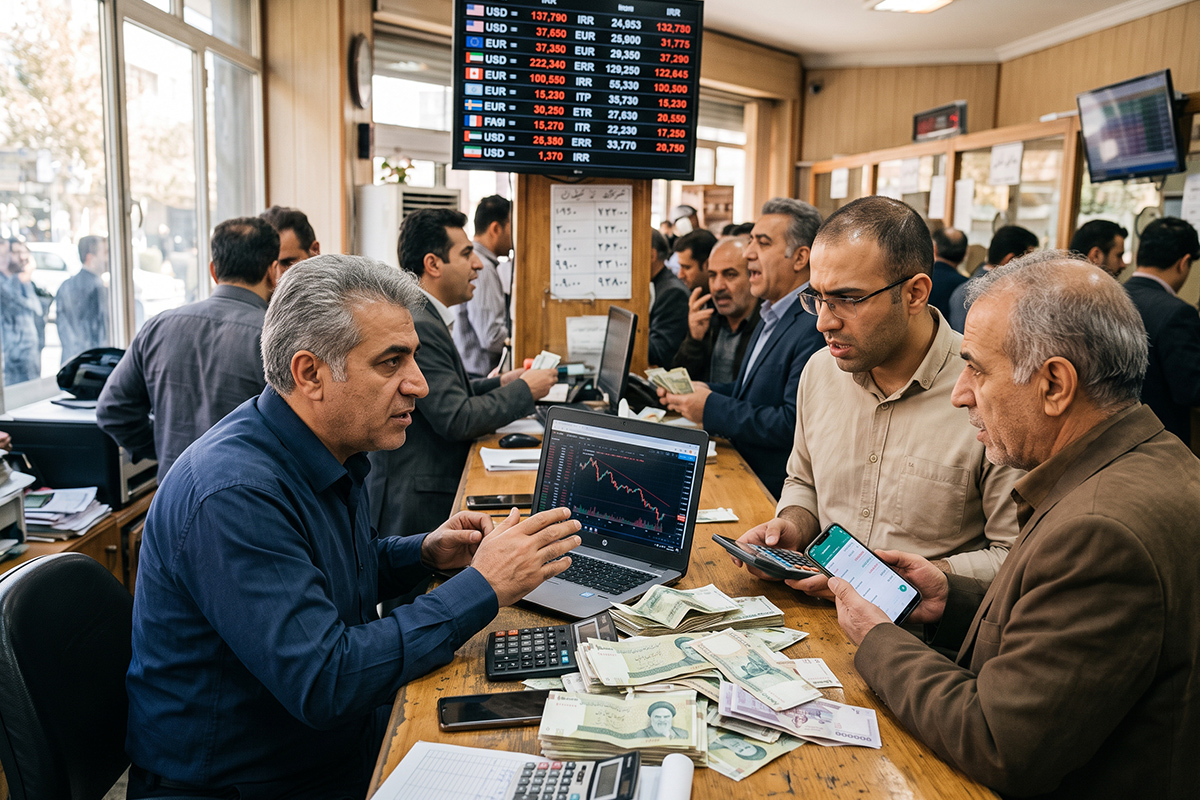




The decline of Iran’s currency is no longer an exceptional event in an economy that has spent years under the pressure of inflation, sanctions, declining purchasing power and restricted access to international financial markets. But the dollar’s rapid rise to levels approaching 260,000 tomans has brought the issue back to the forefront from a different angle.
The question is no longer simply that the currency is moving downward, but rather the speed and scale of that movement within a limited period, at a time when economic pressures are increasingly intertwined with political and military risks that markets find difficult to separate from one another.
The most direct explanation for this decline does not require assuming the existence of a hidden policy behind it.
The Iranian market already carries a range of factors capable of putting pressure on the currency, beginning with high inflation and declining confidence in the toman’s purchasing power, continuing through sanctions and restrictions on financial and commercial transactions, and extending to rising demand for dollars and gold whenever individuals and businesses feel that the economic outlook has become more uncertain.
Nevertheless, the speed of the decline opens the door to another interpretation. It cannot be treated as an established fact, but it deserves consideration as an economic hypothesis.
The idea is that allowing a degree of currency and price repricing now may form part of an attempt to adapt the economy to a more difficult phase, rather than exhausting resources defending price levels that could become increasingly costly to maintain if external pressure intensifies or the country is exposed to another shock.
When Today’s Shock Becomes Less Costly Than Tomorrow’s
This hypothesis is based on a familiar principle in economic crisis management: maintaining an artificially fixed price for a commodity or currency under severe pressure may postpone the problem without eliminating it, while accumulated imbalances can make the eventual correction considerably more severe.
For this reason, some countries facing exceptional conditions resort to repricing, reducing subsidies or allowing their currencies wider room to move when the cost of maintaining fixed levels becomes too high.
From this perspective, the fall of the toman can be viewed differently from a simple collapse.
Authorities may be facing a trade-off between consuming more resources to defend the exchange rate and accepting a weaker currency that better reflects new economic conditions, particularly if economic forecasts assume continued sanctions, trade restrictions and higher costs of obtaining foreign currencies.
Accepting this hypothesis, however, does not mean that the state created the crisis or controls all of its details.
There is a significant difference between a government allowing the market to move under existing pressures and the government itself creating those pressures in the first place.
A weakening currency can also move beyond the levels authorities intended to tolerate, especially once negative expectations translate into rapidly rising demand for foreign currencies.
When an Economy Prepares for the Worst
The possibility becomes more interesting when placed within the broader regional context.
Iran is not currently dealing with an economic variable isolated from politics and security. It is operating in an environment in which continued economic pressure may coexist with the possibility of military escalation.
Any state facing similar circumstances would have to think about supply security, reserves, foreign currency, essential commodities and the capacity of the state budget to withstand prolonged disruptions.
From this perspective emerges the hypothesis of “absorbing the shock in advance.”
The theory assumes that an economy may gradually be pushed toward price levels closer to those expected under more difficult conditions, so that the full repricing does not occur at the precise moment when a crisis reaches its peak.
The idea can be illustrated through commodity markets.
If a country expects the supply of an essential commodity to decline over the coming months, maintaining an excessively low price could allow consumption to continue at the same level until the actual shortage begins.
Raising the price or reducing subsidies, however, could lower demand and preserve part of the available stock for a longer period.
Applying this example to a currency requires considerably greater caution, because the dollar is not an ordinary consumer commodity. The exchange rate directly or indirectly affects almost every part of the economy.
The Other Side of the Equation
The problem with interpreting the decline of the toman as an entirely calculated measure is that a weaker currency does not generate benefits without imposing substantial costs.
A rising dollar increases the cost of imported goods and raw materials. That increase gradually feeds into food prices, services and production costs.
It also erodes the value of savings and wages denominated in local currency, which can raise inflation and increase demand for foreign currencies rather than reduce it.
A simpler explanation for what is happening can therefore be offered: the market itself may be repricing Iranian risk.
As the likelihood of sanctions increases, foreign-currency inflows weaken or fears of military confrontation rise, individuals and companies tend to seek assets capable of preserving value.
When demand for dollars and gold increases, the local currency comes under additional pressure, and that pressure can accelerate once negative expectations become collective behavior.
Under this interpretation, the dollar’s rise to high levels is not part of a plan to prepare the economy for war.
Instead, it is the natural consequence of long-standing economic problems being compounded by a new layer of political and military risk.
For that reason, drawing a direct connection between the exchange rate and a political decision concerning war or negotiations goes beyond what economic data alone can establish.
Between an Unmanaged Collapse and Repricing
The picture may not be limited to two completely opposing explanations: either a government deliberately devaluing its currency or a market that has moved entirely beyond control.
There is a third, more complex possibility.
Real pressures may be pushing the toman downward at the same time that economic policy is adapting to a new exchange rate rather than attempting to restore the currency to levels that current economic conditions can no longer easily sustain.
This possibility means that the state does not need to have caused the decline in order to benefit from some of its consequences or rebuild its policies around the new reality.
Likewise, government intervention to prevent more violent fluctuations does not necessarily contradict a willingness to accept a weaker exchange rate than before.
There is a significant difference between defending a specific currency value and trying to prevent a disorderly market collapse.
From a fiscal perspective, a rise in foreign currencies increases the local-currency value of some dollar-denominated government revenues when they are converted into domestic currency.
At the same time, however, it increases the cost of imports, subsidies and government spending linked to international prices.
The weakening of the toman therefore cannot be treated as a net gain for the treasury or as an easy instrument for solving fiscal problems.
Does the Currency Reveal Preparation for a Different Phase?
If the hypothesis that Iran is preparing for a larger shock is correct, the dollar exchange rate would not be the only evidence.
Its effects should become visible across a broader set of policies, including management of essential-goods imports, the scale of subsidies, liquidity controls, the use of foreign reserves, management of energy and food supplies, prioritization of public spending and maintenance of stockpiles capable of withstanding potential disruptions.
If, by contrast, policy measures remain primarily concentrated on stopping the currency’s decline, injecting foreign currency into the market, reducing speculation and restoring market confidence, that would give greater weight to the explanation of a monetary crisis than to the hypothesis of deliberate repricing.
In either case, the toman alone does not provide evidence that Iran has made a decision to enter a confrontation or closed the door to a settlement.
Governments routinely prepare for scenarios they do not necessarily want to occur, and hedging against the possibility of escalation does not mean escalation has become the final political choice.
What the movement of the toman reveals more clearly is that Iran’s economy is pricing in a high level of uncertainty.
The dividing line between political, economic and military risks has become narrower than before, meaning that any change in one of these areas can quickly be transmitted to the foreign-exchange market, domestic prices and public expectations.
For this reason, describing what is happening as a “planned collapse” may be more definitive than the evidence allows, just as attributing it solely to sanctions could oversimplify a more complex situation.
Between the two interpretations, the scenario most open to objective testing is that the economy is facing genuine and substantial pressures while domestic policy attempts to adapt to them and prepare for the possibility that the next phase will be more difficult.
That does not necessarily mean that the path toward war or settlement has already been decided.


Comments