




By Basim al-Zaidi
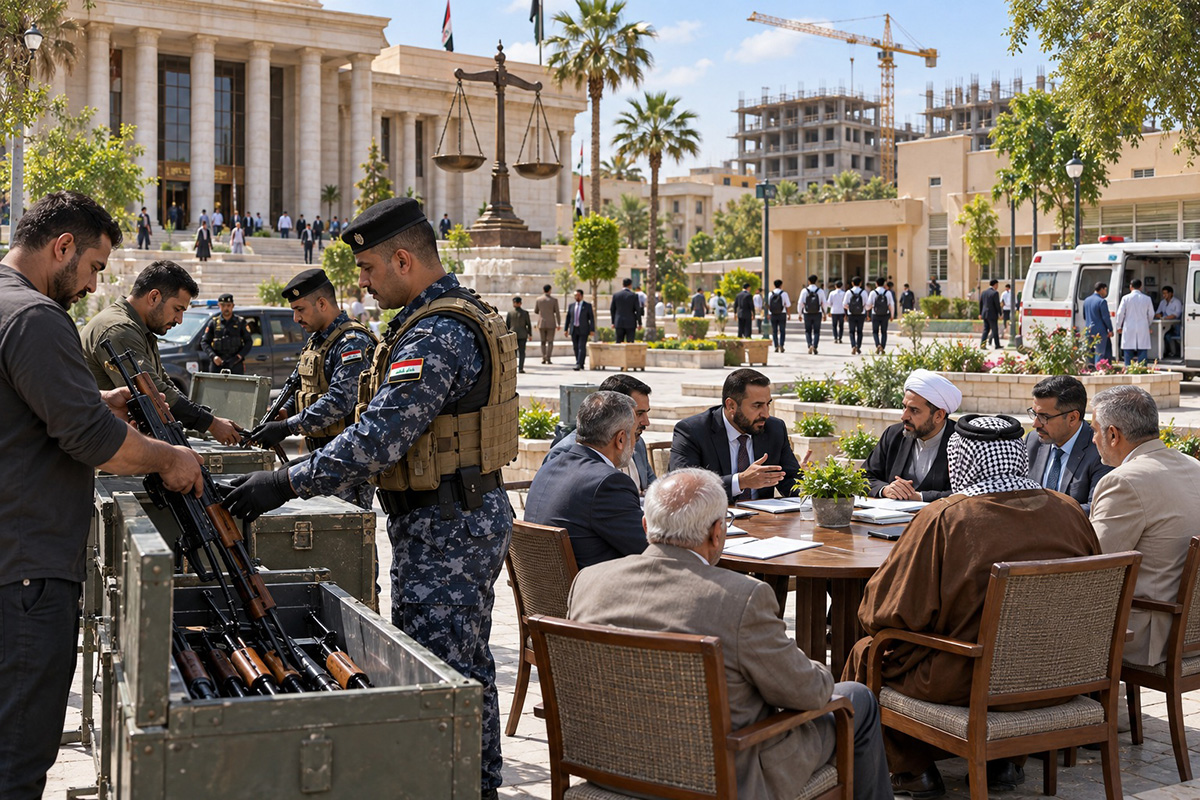
The proliferation of weapons outside official institutions and the militarization of public space in Middle Eastern countries represent one of the most complex structural obstacles to building a modern state and consolidating social peace. When armed force ceases to be an exclusive instrument of the state’s security and military institutions and becomes distributed among parallel forces and groups, the inevitable consequences are the weakening of the social contract, the fragmentation of a shared national identity, the replacement of institutional logic with the logic of domination and coercion, and an escalation of violence within society.
Historical and political experience across the region shows that relying on force to impose faits accomplis or settle intellectual and political disputes has never produced genuine stability. Instead, it has repeatedly reproduced crises and deepened disorder. From this perspective, there is an urgent need for a strategic transition from the “power of arms,” with its destructive consequences for both state and society, to the “power of dialogue” as the only civilized and institutional approach capable of producing sustainable stability, safeguarding human dignity, and encouraging development, prosperity and progress.
The Environment That Sustains Militarization
The proliferation of weapons and the erosion of the rule of law in society did not emerge by chance. They are the result of accumulated political and social conditions across the region. The most important drivers can be identified as follows:
1. Declining Effectiveness of Central Institutions
The inability of the state, during certain transitional periods, to enforce security and administer genuine justice pushed individuals and groups to seek alternative forms of protection, fueling tribal and factional armament.
2. Closing Channels for Political Partnership
When pluralism declines and channels of dialogue among national components are closed, a mistaken perception emerges that possessing instruments of force is the only way to establish political presence or secure rights.
3. Regional Polarization and Conflict Dynamics
Protracted conflicts and external interventions have contributed to the flow of weapons into social spaces, turning some areas into open arenas for settling political scores at the expense of citizens’ security.
4. The Decline of Equal Citizenship
The failure to firmly establish the principle of citizenship, in favor of narrower identities, has transformed weapons into instruments for expanding social influence and entrenching quota-based arrangements within the structure of the state.
The Cascading Effects of Uncontrolled Weapons
The consequences of weapons existing outside official state institutions do not stop at the political or security sphere. They cast a heavy shadow over virtually every vital component of development and society.
Security breakdown and the spread of weapons represent major obstacles to comprehensive development. Capital requires a secure and stable environment, while the existence of armed centers of influence operating beyond the law drives domestic capital away, restricts foreign direct investment, and encourages economic extortion and the imposition of protection payments on commercial and industrial projects.
This situation also drains state budgets by redirecting public resources toward tactical security responses rather than investment in productive and service-oriented projects.
The spread of weapons throughout public life also strikes at the developmental foundations of the educational system. The status of knowledge and education declines in favor of a culture of force and alternative centers of influence.
Tension and violence then spill into schools and universities, threatening the environment necessary for scientific research and academic stability. This also contributes to the migration of scientific talent, academics and medical professionals in search of safer environments capable of accommodating their skills and potential.
Vital public-service sectors, including healthcare, electricity, water and road infrastructure, are also directly affected by security instability. Engineering and service personnel are prevented from carrying out their work, while companies implementing projects may suspend operations because of security threats and extortion.
This reality deprives citizens of some of their most basic service-related rights and weakens the ability of official institutions to distribute development projects fairly because of pressure from armed centers of influence.
Uncontrolled weapons also fragment national bonds and replace judicial justice and formal legal institutions with customary rules or the logic of force. The consequences include rising organized crime, escalating armed factional disputes, and the spread of fear and psychological insecurity throughout society.
This weakens the values of tolerance and human solidarity in favor of division and social fragmentation.
Foreign policy and the state’s regional standing are likewise negatively affected when multiple centers of power exist within the country. State borders become sources of security concern for neighboring countries, obstructing trade and mutually beneficial economic projects.
This also weakens the position of official diplomacy and prevents the development of integrated strategic partnerships that Middle Eastern states need to strengthen their shared economic security.
State Monopoly on Weapons and the Rule of Law
Islamic legal principles and rational political thought converge on the idea that protecting society and guaranteeing stability require a single legal authority with exclusive control over the instruments of law enforcement, in order to prevent chaos and protect individual rights.
Quranic legislation established peace as a fundamental principle in the management of society while warning against security breakdown whose harm can affect everyone without exception. Almighty God says:
“And beware of a trial that will not afflict only the wrongdoers among you, and know that Allah is severe in punishment.”
In the political thought of the Commander of the Faithful, Imam Ali ibn Abi Talib (peace be upon him), we find a precise foundation for the necessity of a unifying authority that exclusively administers public affairs and prevents armed struggles for supremacy among individuals and groups.
In Nahj al-Balagha, Imam Ali explains the importance of political and institutional organization in preserving stability and securing public roads. Responding to one of the Kharijites regarding legitimate authority after they raised the slogan “No rule but God’s,” he explained that it was “a word of truth by which falsehood is intended,” and said:
“People must have a ruler, whether righteous or wicked, under whose rule the believer works and the unbeliever enjoys his worldly share; through whom God brings matters to their appointed term; through whom revenues are collected, enemies are fought, roads are secured, and the rights of the weak are taken from the strong, until the righteous find peace and relief is gained from the wicked.”
This text establishes a governing conceptual principle: the weak cannot be protected, roads cannot be secured, developmental resources cannot be organized, and borders cannot be defended without a single executive authority represented by the legitimate state.
Implicitly, this rejects the existence of any parallel armed force that competes with the state in carrying out its security responsibilities.
These principles also converge with the intellectual and political approach of the late religious authority Imam Sayyid Muhammad al-Husayni al-Shirazi, whose writings were devoted to establishing the concepts of nonviolence, consultation and peaceful pluralism while calling for the dismantling of the culture of militarization and coercion.
The strategic dimensions of this intellectual approach can be identified through several central principles:
First: Giving Consultation Priority Over Coercion
The Shirazi approach begins from the premise that societies should be governed through the will of the people, expressed through consultation, political pluralism and the peaceful transfer of power.
It emphasizes that monopolizing authority and relying on force are among the primary generators of crises and conflict.
Second: Institutional Development and Civil Empowerment
From this perspective, the strength of societies is not measured by the volume of weapons present in public life, but by the development of their civil institutions, the independence of their associations, and the maturity of their cultural and social consciousness based on mutual understanding.
Third: Rejecting Coercive Means of Reform
The Shirazi approach holds that violent means produce outcomes that resemble the means themselves.
Using coercion to manage crises generates only new forms of authoritarianism or widespread chaos, whereas dialogue and peaceful consensus provide the only path capable of protecting human dignity and building internal stability.
The Peaceful Transfer of Power
The danger posed by the proliferation of weapons extends beyond immediate security threats. It becomes a structural obstacle to the development of political life in Middle Eastern states.
One of the clearest manifestations of this obstruction is the effect of armed power on electoral choice. When certain political forces possess weapons, electoral competition shifts from a contest between programs into a process shaped by coercive influence and implicit intimidation, hollowing out the democratic process by undermining freedom of choice.
The influence of armed power also sidelines civilian elites and professionals, marginalizing academic, technocratic and other qualified groups in favor of entities whose influence depends on weapons.
This weakens the ability of parliaments and governments to engage in strategic planning and administer state institutions professionally.
Uncontrolled weapons also prevent political agreements from becoming stable, because election results and legally negotiated understandings remain vulnerable to obstruction or pressure under the threat of force.
Foundations for the Transition
Moving from an environment of militarization to one governed by law requires a comprehensive strategy that establishes dialogue as a permanent institutional mechanism for managing political, sectarian and ethnic diversity across the region.
Such a strategy should rest on the following foundations:
1. Establishing Equal Citizenship
Citizenship should become the sole constitutional standard for rights and duties, without preference based on factional, partisan or ethnic affiliation.
2. Institutionalizing Consultation and Pluralism
All national political forces should be given the opportunity to express their views and conduct their activities through peaceful channels and formal constitutional frameworks.
3. Judicial Independence
A strong and effective judiciary must be built, capable of protecting individuals and resolving disputes without being influenced by pressure from powerful forces operating outside the state.
4. Supporting and Empowering Civil Society
The role of trade unions, civil associations and cultural institutions should be strengthened so that they can serve as peaceful bridges between citizens and the state.
Recommendations
To implement this vision across Middle Eastern societies, an interconnected package of legislative, economic and cultural measures can be recommended:
First: The Legislative and Security Sphere
1. Enforce Laws Restricting Weapons to State Institutions
Existing legislation should be implemented to ensure that possession and use of medium and heavy weapons are restricted exclusively to officially recognized military and security institutions.
2. Modernize the Security Sector on Professional Foundations
Security institutions should be built according to inclusive national standards of competence and insulated from factional or particularistic polarization.
3. Implement Weapons Collection and Prohibition Programs
Governments should establish organized national plans to purchase or collect uncontrolled weapons according to defined timetables and carefully designed compensation or integration mechanisms that provide genuine civilian alternatives.
Second: The Economic and Development Sphere
1. Redirect Resources Toward Development
Government spending should prioritize education, healthcare and infrastructure capable of attracting both domestic and foreign investment.
2. Address Marginalization and Poverty
Strategic development projects should be launched in less-developed regions in order to reduce the social conditions that can be exploited to recruit young people into armed structures.
3. Support Initiatives and Economic Empowerment
Accessible loans should be provided and private-sector investment facilitated to absorb young people’s capacities and direct them toward production and civilian employment.
Third: The Cultural and Educational Sphere
1. Develop Educational Curricula
School curricula should be revised to remove concepts that glorify violent force or exclusion and to instill the values of tolerance, dialogue and the rule of law.
2. Promote Responsible Media Discourse
Media platforms should not be used for factional incitement or to justify the possession of weapons outside official state institutions.
3. Promote a Culture of Peace and Consultation
Religious texts and the reformist perspectives they contain should be highlighted to promote the protection of human life, the spread of peace, and the primacy of dialogue and reason over force and coercion.
Conclusion
Middle Eastern states, with their human, economic and civilizational resources, today face a decisive choice between continuing along the path of militarization and fragmented centers of power—with the poverty and developmental decline that follow—or courageously beginning a transition toward the “power of dialogue,” institutional government and the rule of law.
Restricting weapons to state authority is not merely a security policy. It is a strategic decision about how the present and future will be built.
It is a fundamental gateway to preserving human dignity, protecting the economy and providing hope for future generations.
Giving priority to dialogue, consultation and respect for justice is the only path capable of transforming societies from centers of instability into centers of development and sustainable social peace.


Comments