
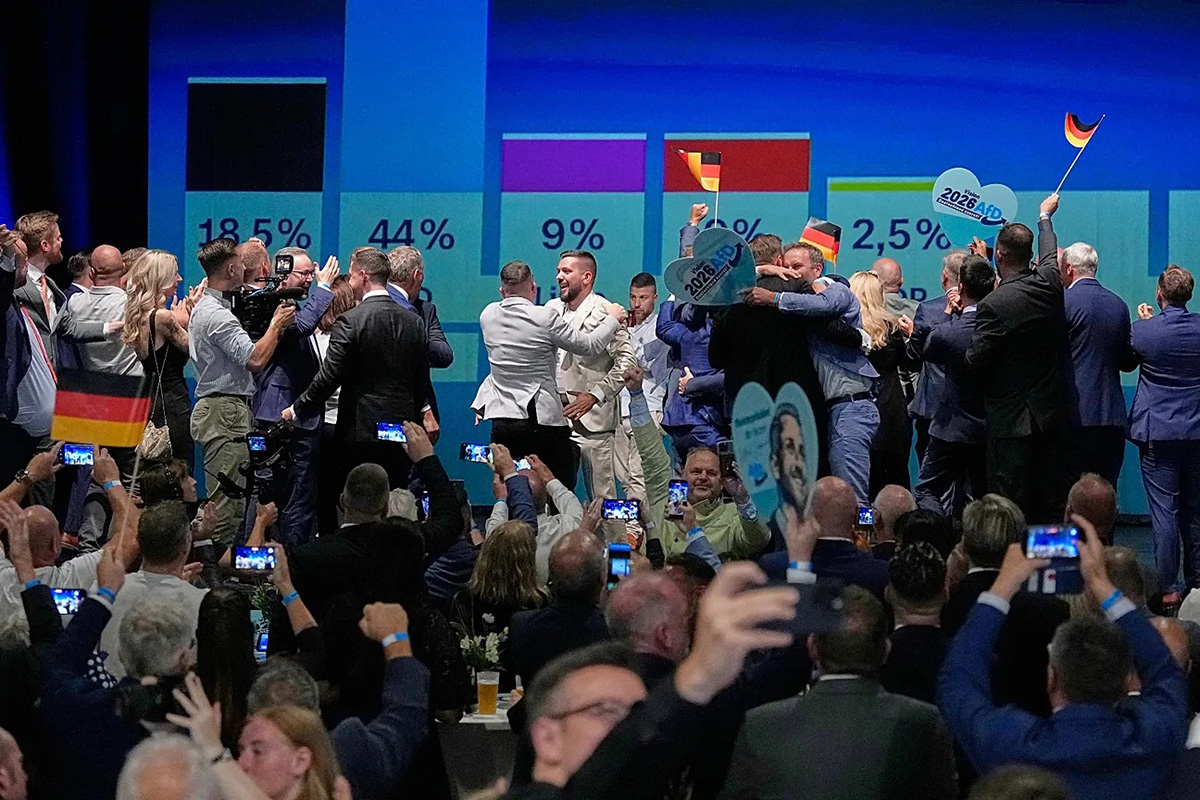




The shifts underway across Europe’s political landscape are no longer confined to the advance of right-wing parties in smaller countries or on the geographical fringes of continental decision-making. Elections in the German state of Saxony-Anhalt propelled the Alternative for Germany (AfD) to the forefront after it secured around 44 percent of the vote, its strongest result ever in a state election, placing it well ahead of the Christian Democratic Union and bringing it closer to a political territory that Germany’s radical right had been largely excluded from throughout the decades following World War II.
The significance of the result does not stem from the size of the state alone, nor does it mean that Germany has fallen under radical-right rule, since the party failed to secure an absolute majority and major political formations still refuse to cooperate with it. Yet the outcome reopens a question extending far beyond Germany: the direction in which Europe itself is moving. Different right-wing forces have become influential participants in government or serious contenders for power in Italy, France, Germany and elsewhere, while conservative governments have adopted tougher positions on migration, borders and identity that only a few years ago were more closely associated with parties on the margins of the political system.
Germany: When the “Firewall” Began to Lose Its Strength
For years, Germany’s party system relied on what became known as the “firewall,” a consensus among mainstream parties that ruled out governing cooperation with the Alternative for Germany regardless of its electoral performance. That policy worked when the party represented a relatively limited force that could be kept in opposition without obstructing the formation of governments. But its growing share of the vote has altered the political calculus, because excluding a party supported by more than four out of every ten voters forces the remaining political forces to pursue increasingly complex alliances simply to preserve the firewall itself.
In Saxony-Anhalt, the AfD won 39 of the state parliament’s 83 seats, leaving it short of an outright majority. However, the entry of the Sahra Wagenknecht Alliance into the regional parliament after it crossed the five-percent threshold opened a possibility that had not previously existed in the same form. Representatives of the alliance expressed readiness to hold talks with all political forces, including the AfD, despite the considerable ideological differences between them. The question therefore shifts from how many votes the right can win to whether the political system can continue isolating it if its popular base keeps expanding.
Before the election, Michael Bröning had warned that closing ranks against extremist parties could not serve as a permanent substitute for effective governance, because the success of a political firewall ultimately depends on the isolated force remaining below the majority threshold that would allow it to reach power without partners. The Saxony-Anhalt result did not bring the firewall down entirely, but it made the political cost of maintaining it considerably higher than before.
Economy and Migration: The Conditions That Expanded the Right’s Electoral Base
The rise of the AfD, and of the European right more broadly, cannot be explained by migration alone, despite the central role the issue plays in the rhetoric of these parties. The economic and social transformations Europe has experienced in recent years have also widened the political space available to forces presenting themselves as alternatives to the traditional parties.
In Germany, the Saxony-Anhalt result was linked to dissatisfaction with the federal government, bureaucracy, rising living costs and concerns over pensions and the future of the economy, all at a time when the government faces pressure to implement unpopular economic and social reforms. The election result also reignited divisions within Chancellor Friedrich Merz’s coalition over those reforms, while providing the AfD with fertile ground to present itself as the clearest opponent of the established political order.
Economic and historical disparities between eastern and western Germany add another layer to the picture, along with a sense among sections of the population in the eastern states that they have not received an equal share of prosperity since reunification. There are also differences in attitudes toward Russia and the war in Ukraine. Parts of eastern Germany have retained a more complex relationship with Moscow because of the former East Germany’s history, giving the AfD’s call for restoring relations with Russia and reducing support for Ukraine greater appeal among some voters.
The Right Wants More Than a Change in Migration Policy
The advance of Europe’s right is not only about borders and migrants. Some of its forces seek to redefine the relationship between the state, identity, culture, education and history. In Germany, this dimension emerged in the debate over the AfD’s stance toward the Bauhaus school and the legacy of modern architecture. Scholar Jan-Werner Müller argues that the party’s interest in cultural policy is far from incidental, because local authorities can use such policies to exert direct influence over institutions, curricula, public symbols and the way society defines its own identity.
The AfD’s program in Saxony-Anhalt offers a clearer picture of the form of government it seeks to establish if it succeeds in taking power. It includes stricter deportation measures, changes to certain education policies, a review of public broadcasting and changes to the operation of the domestic intelligence agency that previously monitored the party, alongside a stronger presence for national symbols in public life. Its plan for its first 100 days indicates that moving from opposition into government would not simply mean replacing one administration with another, but attempting to implement a different political and social vision across multiple areas.
Germany Is Not an Isolated Case
Looking at Germany in isolation from the rest of Europe could create the misleading impression that these developments are merely a product of the particular conditions of the eastern states. The continental picture, however, shows that right-wing forces have become major political actors to varying degrees, even though their trajectories differ from one country to another.
In Italy, Giorgia Meloni succeeded in transforming the right’s experience from opposition into relatively stable government, while more hardline forces have emerged to the right of her administration, including Roberto Vannacci’s National Future party. Vannacci has called for an end to further European political integration and for the European Union to become a framework for cooperation among sovereign states rather than an institution with expanding supranational powers. He has portrayed the rise of Germany’s AfD and the strength of France’s National Rally as elements of a new European political future.
France represents the most sensitive test after Germany, because the National Rally can no longer easily be treated as a marginal party, while recent polls have shown Marine Le Pen capable of leading the first round of the presidential election scheduled for 2027. If a major political shift were to take place in France while the AfD continued advancing in Germany, the issue would no longer concern individual European governments alone, but the continent’s two largest and most influential economies and, by extension, the direction of the European Union itself.
The picture, however, is not moving entirely in one direction. Hungary offered a counterexample in 2026, when Viktor Orbán lost power after sixteen years in office, demonstrating that the success of nationalist and conservative forces does not necessarily create an irreversible political cycle. The same voters who bring a right-wing party to power may later punish it for the same economic and political reasons that brought down its predecessors.
There Is No Single European Right
Using the term “the right” to describe all these political forces conceals significant differences between them. Some are traditional conservative parties operating within European institutions and supporting NATO. Others are nationalist parties that seek to reduce Brussels’ authority while remaining inside the European Union, while still others adopt more radical positions on migration, the euro and relations with Russia.
Even right-wing movements that share a focus on sovereignty, borders and identity differ on economic policy, foreign affairs, Ukraine and the nature of relations with the United States. The prospect of forming a unified European right-wing front is therefore more complicated than the electoral map might suggest. These parties may cooperate over migration or the powers of the European Union, only to diverge sharply when the debate turns to Russia, budgets, trade or military spending.
For this reason, speaking of “a Europe governed by the right” does not necessarily imply the existence of a single ideological project spreading from Rome to Berlin and Paris. It may instead point to a shift in Europe’s political center of gravity toward a more conservative and nationalist space, while substantial differences persist among the forces operating within it.
When the Right Wins Without Entering Government
The most important transformation may occur even if several radical-right parties remain outside government, because electoral success can reshape the policies of their rivals before it changes the governments themselves. When parties advocating tougher migration policies win large shares of the vote, conservative and centrist parties face two difficult choices: either continue with their existing programs and risk losing more voters, or move closer to some of the right’s demands in an attempt to win those voters back.
This process has already emerged in migration policy across several European countries. In Sweden, for example, the right-wing government adopted a program offering financial payments to some migrants from outside the European Union in return for voluntarily returning to their countries of origin, as part of a tougher migration policy supported by the right-wing Sweden Democrats. The example illustrates how ideas once considered radical can gradually move into official government policy without the most hardline party necessarily taking control of the government.
In this sense, the right can achieve a political victory before securing a governmental one, simply by forcing its rivals to contest elections on an agenda it has defined. Borders, deportations, identity and national sovereignty then move to the center of political competition instead of remaining on its margins.
What Changes if the Right Reaches Europe’s Main Centers of Power?
If the current trend continues and nationalist right-wing forces enter government or gain greater influence in Germany and France, the consequences will extend beyond domestic policy to the structure of the European Union itself, because Berlin and Paris have historically served as the principal engines behind most major European integration projects.
Migration would be among the first areas likely to change, with tighter restrictions on asylum, faster deportations and stronger controls on external borders. In economic policy, pressure could grow to protect national industries and reconsider some European regulatory rules. Relations with Brussels would also likely become more contentious, intensifying the struggle between forces seeking deeper integration and those demanding that powers be returned to national governments.
The war in Ukraine represents a more sensitive point of disagreement. The AfD calls for reducing support for Kyiv and improving relations with Moscow, a position that differs from the policies of Germany’s current government and several other conservative European governments. The party’s opposition to the single European currency has also made its rise a matter of economic concern as well as political significance, although markets have so far treated the Saxony-Anhalt result more as a political warning than an immediate economic threat.
Europe Between the Rise of the Right and the Crisis of the Center
The German results do not prove that Europe has definitively entered an era governed by the right, but they do reveal that a political system long dominated by center-right and center-left forces no longer functions as it once did. Declining confidence in traditional governments, economic pressures, migration, war and debates over national identity have all opened political space for parties once considered marginal to become electoral forces that are increasingly difficult to ignore.
These parties still face another hurdle beyond winning elections: proving that they can manage economies and institutions and build sustainable coalitions once they move from protest into responsibility. Italy’s experience demonstrates that a right-wing government can endure, while Hungary shows that such rule is not guaranteed to last. Germany, meanwhile, remains suspended between a major electoral victory for the AfD and the possibility that the party may still be unable to form a government.
The central question, therefore, may not be whether Europe will wake up one morning to find itself governed by the right, but whether a slower transformation is already underway, shifting the dividing line between the center and the right and turning ideas that a decade ago belonged to the rhetoric of fringe parties into permanent features of government programs and electoral competition.
If this transformation continues, the new era will not necessarily begin when a right-wing party takes control of every European capital, but when the right becomes capable of determining the issues around which those capitals compete, whether it is inside government or outside it. From this perspective, Saxony-Anhalt matters less as an isolated German state and more as an early test of a larger European question: can the political center still win back the voter, or has the center of European politics itself begun to move elsewhere?


Comments